The hang gliding pilot is now neglecting apples
Archive Večera date 23-07-2007, page 24
Maribor's Primož Gričar, the best „solar-powered“ kite pilot in the world, now a professional
Our best glider Primož Gričar from Partinje near Maribor, who competes in the classic class and the iclass of hard-winged hang gliders, has once again broken through to the first place on the world list of the best glider kitesurfers FAI class 5. It is a scale of the World Aviation Association, which is the umbrella organization of all aviation sports from competitions with airplanes, balloons and gliders to competitions with kites and parachutes.
Gričar was ranked first in his class on this scale as early as 2005, but then slipped to second in mid-2006. Thanks to his excellent results last season and at the beginning of this year, he once again took the lead in the best hard-core gliders in the world. Only a few athletes in Slovenia can boast of such exceptional success, especially if we take into account that hang gliding is much more popular in developed countries than in our country, and the interest in it is growing. Some predict that hang gliding will become one of the most popular adrenaline sports, to which television broadcasts with cameras mounted on kites are expected to contribute.
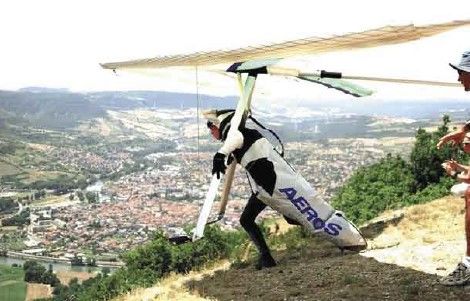
Gričar's hang glider (Tomaž Kšela)
Gričar started this season brilliantly. “At the beginning of April, I won the 2007 Trophy Montegrappa Hang gliding Flight Competition in Italy. A few days after that, I took part in two ordinary hang gliding races in Florida, which I used to train before the World Championships in Texas in August. At the Alpine Open in early June in Innsbruck, I also took first place in the hardwing category. At the pre-European championships in Greifenburg in the Drava Valley in Austria, I was second with an ordinary glider. I won first place at the Croatian Open with an ordinary glider. I won second place at the German Open Championship with hardwings, " lists his successes this season our best hang glider going to the World Hang Gliding Championships in the USA
Among professionals
Primož Gričar received the Cizl Award for sports achievements in 2006, he is a university graduate engineer of agronomy, and is enrolled in a master's degree program. He used to do hang-gliding non-professionally, as he took care of growing apples on his home farm, while many of his competitors from abroad were involved in hang-gliding almost professionally. He recently joined them among the professionals, as he was the only pilot to work at the Aeros factory in Ukraine, which produces kites. Also due to his success, there is a growing demand for dragons from this factory in Europe. Without the support of the sponsor, Gričar would not have been able to break into the world elite only with the support of the Slovenian Aviation Association, which has helped him a lot so far, even though he is in the Slovenian national kite flying team.
The excellent results he achieved in 2005 at the Flytec Championship in the USA, at the German Open Championship and at the Alpine Open Championship also contributed a lot to Gričar breaking through to the top of the FAI Class 5 world rankings again. He also started last season encouragingly, finishing second in Class 5 in the spring race for the Montegrappa trophy in Italy. At the World Championships in Florida, things did not go as he expected, so he landed in not the best 12th place for him, although this is also a respectable result.
As a result, he slipped to second place in the rankings at the end of the 2006 season. However, with good results, he once again broke into the top of the world rankings of hard-wing gliders.
Primož Gričar hopes that kite sailing will become an Olympic sport. (Tomaž Kšela)
In addition, Gričar achieved excellent results last year in competitions with the classic glider. In the FAI class 1 competitions, he achieved second place at the Slovenian Open Championships and third place at the European Championships in Croatia, in which 96 competitors from almost all European countries took part. The bronze medal from the European Championship, which is ranked the highest, as the competition is the strongest, was his best result last year, for which he won the Cizl Award.
Interesting fact
With favorable thermals and wind, a sailor can fly 60 to 100 kilometers in one hour
High above the clouds
How do hang gliding competitions take place in the first place? “Before the competition, which usually starts around 10 am, the competitors are given a task, which is determined by the organizers according to the weather conditions. Competitors need to fly over several well-defined checkpoints and reach the goal in the shortest time. In the most demanding competitions, we have to fly up to 250 kilometers in one day at an altitude of up to 4000 meters. We are also in the air for up to 6 hours. With favorable thermals and wind in the back, a sailor can fly 60 to 100 kilometers in one hour, but it is much slower if the thermals are not favorable and if the wind does not help him, ”explains Gričar.
What can a competitor do in the air? "In the case of classic kites and hardwings, in addition to the glider, the competitor also has a warm airplane bag, a flight computer with GPS equipment (the flight of kites is monitored by satellites, so subjective judgments of judges are not possible)“ Gričar laughs. "The sun is essential for us. We hang gliders are solar powered pilots. The sun heats the floor surfaces. The air above different surfaces heats up at different speeds. For example, the air above the slopes heats up faster than on flat ground. The air above the factory roofs heats up faster than the air above the forest surfaces and the like. Due to temperature differences, warm air begins to rise, which we take advantage of. Sometimes a kite pilot in a thermal column can also climb at a speed of about 14 meters per second. If it encounters a layer of cold air, however, it begins to fall at a speed of 10 or more meters per second. In such conditions, the pilot must react extremely quickly to recapture the appropriate thermal currents, which are invisible to strangers and the pilots see them by indirect signs (clouds, mists, birds, insects, trees and the like). In the absence of thermals, the sailboat falls due to gravity at a horizontal speed of 45 kilometers per hour at a speed of one meter per second. Due to all these circumstances, every kite flight requires maximum concentration from the pilot, regardless of whether it is a competition or not. Major mistakes and carelessness in our sport cannot be corrected, so kite pilots must have mature and responsible personalities."
Therefore, in order to exclude the influence of coincidences in competitions, competitors compete several times in one competition. Competitions usually last from three to 14 days. If the weather is nice, the competitors take one flight every day. Thus, knowledge, experience, endurance and ability to fly really decide on the ranking. Gričar made 40 flights at competitions last year, and was in the air for a total of 90 hours. During this time, he flew thousands of miles. According to him, kite-sailing competitions are becoming more and more interesting and attractive, as they have already been watched on television in many parts of the world. Particularly attractive are the shots from cameras mounted on hang gliders. Many find that the footage is often even more exciting than in Formula 1, so public interest in the sport is growing rapidly.
"Unfortunately, none of the air sports is an Olympic sport, although free flying is basically an athletic sport. Therefore, I hope that it will soon be an Olympic sport, as the results in this sport depend only on the pilot and his psychophysical readiness and endurance," said Gričar., who also prepared well for the World Cup. However, as he says, in this sport, it is never wise to think too much about the outcome, as safety must come first. His goals for the World Cup and this year's season in general therefore remain the same as they were before last season: to achieve maximum perfection in flight, which, while taking care of safety, is the only thing that ensures good results in the long run.